Introduction
In a digital-first market, customers often search online before deciding which business to contact. They want to understand what a company offers, compare options and find a convenient way to get in touch. At the same time, businesses are looking for better ways to manage enquiries, organize information and deliver services. This is where choosing the right digital solution becomes important.
If you are planning to invest in technology, you may be asking: should your business build a website or a web application? The terms are sometimes used interchangeably, but they are not exactly the same. Understanding the purpose of each can help you make a practical decision based on your goals, customers and daily operations.
What Is a Website?
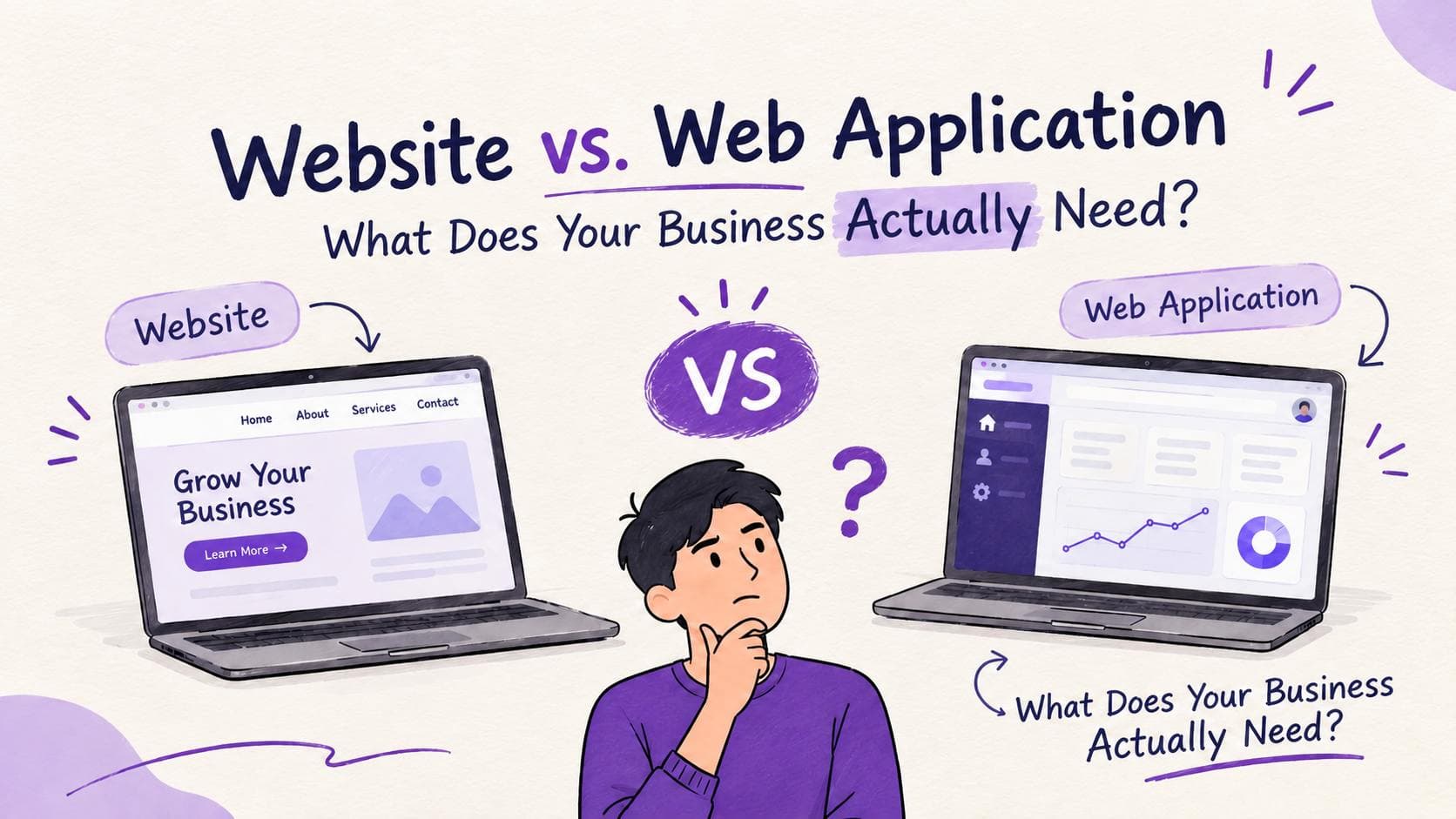
A website is a collection of connected web pages that people can access through a browser. For most businesses, its main purpose is to introduce the company, explain its products or services, share useful information and encourage visitors to take the next step.
A typical business website may include a homepage, About Us page, service or product pages, portfolio, blog and contact details. For example, an education consultancy can use its website to explain available courses, share admission updates, introduce its team and provide enquiry details. A visitor can browse the information, call the office or submit an enquiry form.
A well-planned website gives a business a consistent online presence. It can help potential customers find accurate information, understand what makes the business different and build confidence before making contact. With relevant content, a clear site structure and good technical performance, a website can also support search engine visibility.
Websites are not limited to static pages. They can include forms, chat tools, maps, appointment requests and other interactive features. The important point is that these features support the website's main purpose of informing visitors and helping them connect with the business.
What Is a Web Application?
A web application is software that people use through a web browser. Instead of only reading information, users can sign in, enter or update data, complete tasks and receive results. Web applications are usually designed around a particular service, process or business requirement.
Common examples include customer portals, online booking platforms, student management systems, inventory systems, project management tools and customer relationship management (CRM) systems. Depending on the purpose, a web application may include user accounts, dashboards, databases, notifications, payment features and connections with other software.
For example, an education consultancy could use a student management web application to register applicants, store documents, track application progress and manage communication. Staff members could manage student records through a secure dashboard, while students could log in to check updates or submit required information.
A web application can reduce repetitive manual work and make information easier to organize. However, its development may require more planning because the system needs to handle user roles, data, workflows, security and ongoing maintenance.
Website vs. Web Application: Key Differences
The main difference is the purpose and level of interaction. A traditional website is primarily designed to present information, while a web application enables users to perform tasks and work with data. The distinction is not absolute: modern websites can include interactive features, and web applications often contain informational pages.
Which One Does Your Business Need?
The right choice depends on what you want technology to achieve. Start by identifying the problem you need to solve rather than choosing a technology simply because it is popular.
Choose a Website If...
Your main goal is to establish an online presence, explain your services, showcase your work, publish updates and receive enquiries. A website is often a practical starting point for small businesses, service providers, consultancies and organizations that want customers to find reliable information about them online.
It may be the right option if customers mainly need to learn about your business before contacting you, or if you want to improve visibility through search engines. A well-structured website can also act as the central destination for visitors coming from social media, online advertisements, email campaigns and search results.
Consider a Web Application If...
Your business needs customers or employees to log in, manage records, make bookings, track requests, process transactions or complete a sequence of tasks online. A web application may be useful when your team relies on spreadsheets, paper forms or disconnected tools to manage important processes.
For instance, a service business that handles many appointments may benefit from a booking system. A company managing stock across several locations may need an inventory application. An education consultancy that handles a high volume of student applications may need a portal to organize documents and application updates.
Questions to Ask Before Making a Decision
Before investing in development, consider a few practical questions:
What should the digital solution help the business achieve?
Who will use it: customers, employees, administrators or all three?
Do users only need to view information, or must they complete tasks?
Will the system store personal, financial or business-critical data?
Does it need to connect with existing software or payment services?
What is the available budget for development, hosting, security and maintenance?
Which features are essential now, and which can be added later?
Answering these questions helps define the scope of the project. It can also prevent unnecessary features from increasing development time and cost. A clear requirements plan makes it easier to select a solution that is useful today and adaptable as the business grows.
Can Your Business Have Both?
Yes. A business can use a website to attract and inform visitors, alongside a web application that supports customers or employees after they take action. These solutions can work together when there is a clear need.
For example, an education consultancy could use its website to publish course details, explain its services and receive enquiries. A connected student portal could allow registered students to submit documents, view application progress and receive important updates. The public website helps people discover the consultancy, while the application supports specific tasks after they become users.
The two systems may be integrated so information can move between them, but they do not always need to be built at the same time. A business can begin with the most important requirement and expand its digital setup when its needs become clearer.
Why Planning and Maintenance Matter
Choosing between a website and a web application is only one part of a successful digital project. The solution also needs to be easy to use, secure, reliable and suitable for the people who will depend on it. Mobile responsiveness, page speed, accessible design, data protection, backups and regular updates should be considered during planning.
Remember that development is not a one-time activity. Websites need content updates and technical maintenance. Web applications may also need security reviews, bug fixes, performance improvements and feature updates as business processes change. Planning for ongoing support helps protect the value of your investment.
Final Thoughts
A website helps people discover your business, understand what you offer and get in touch. A web application helps users interact with a service, manage information or complete specific tasks online. Neither option is automatically better; the right choice depends on the problem you need to solve and the experience you want to provide.
Before starting a project, define your goals, understand your users and identify the features that will make a real difference. You may need a professional business website, a custom web application or a combination of both. Start with what your business needs now, while keeping future growth in mind.
At Shakta Technology, we believe effective digital solutions begin with understanding business requirements. Whether you are planning a professional website or a custom web application, our team can help you explore an approach that fits your goals. Get in touch with https://shaktatechnology.com/ to discuss the right digital solution for your business.